Selecting the right 12V battery is essential for RV life, whether you’re chasing off-grid adventures or simply ensuring comfort on the road. The following picks are tailored for American RV enthusiasts, balancing durability, cycle life, safety, and performance across AGM and LiFePO4 chemistries. Each entry highlights how it fits typical RV needs, from camping weekends to long-term off-grid living.
Summary of chosen products:
| Product | Brand | Chemistry | Key Strength |
|---|---|---|---|
| Renogy Deep Cycle AGM 12V 100Ah | Renogy | AGM | Safe, maintenance-free, versatile in series/parallel setups |
| SUPER EMPOWER 12V 100Ah LiFePO4 | SUPER EMPOWER | LiFePO4 | Long cycle life, high energy density, drop-in replacement |
| Weize Deep Cycle AGM 12V 100Ah | WEIZE | AGM | Maintenance-free, low self-discharge, solid capacity |
| Renogy 12V 200Ah AGM | Renogy | AGM | Higher capacity, solid discharge performance |
| ECO-WORTHY 3584Wh 12V 280Ah LiFePO4 | ECO-WORTHY | LiFePO4 | Massive energy storage, Bluetooth monitoring, robust BMS |
These selections focus on balanced weight, safety, and endurance, helping RV setups handle lights, refrigeration, water systems, and media devices without frequent recharges.
Renogy Deep Cycle AGM 12V 100Ah Battery

Renogy AGM batteries are known for safety and reliability in RV, camping, cabins, and marine uses. This 12V 100Ah model supports both series and parallel configurations (up to 4P), enabling flexible expansion for larger RV systems. Its sealed, maintenance-free design minimizes leakage and the need for frequent checks, making it a practical choice for travelers who prioritize simplicity alongside performance.
SUPER EMPOWER 12V 100Ah LiFePO4 Battery

This LiFePO4 option offers long cycle life and high energy density, with an integrated BMS that manages charging, discharging, and temperature control. It is designed as a drop-in replacement for traditional lead-acid or AGM batteries, fitting standard 12V RV compartments and group sizes. Ideal for RVs seeking durable battery life with lighter weight than comparable lead-acid systems.
Weize Deep Cycle AGM 12V 100Ah Battery
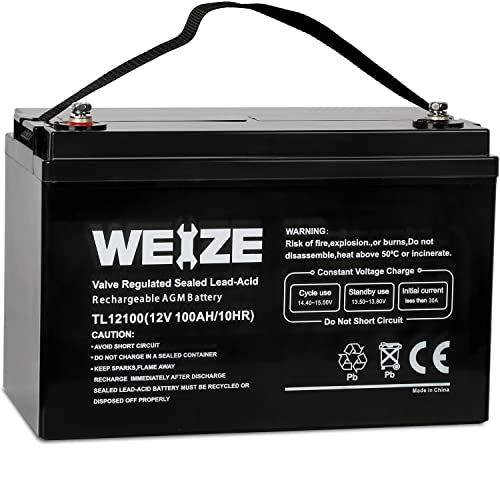
Weize’s AGM design emphasizes maintenance-free operation with a low self-discharge rate. It features a sturdy sealed construction, making it suitable for RVs, solar setups, trolling motors, and off-grid cabins. With a broad operating temperature range, it can handle varied climates, helping ensure consistent performance on trips and in remote locations.
Renogy Deep Cycle AGM 12V 200Ah Battery

This higher-capacity AGM model delivers more stored energy without increasing the number of cells. Its robust design supports heavier load profiles, enabling longer fridge runs, more extensive lighting, and greater utility in larger RV setups. The maintenance-free architecture helps reduce upkeep while maintaining reliable discharge performance.
ECO-WORTHY 3584Wh 12V 280Ah LiFePO4 Battery

This large LiFePO4 option provides substantial energy storage with a built-in 200A BMS and Bluetooth monitoring. It suits RVs with higher power demands or those pursuing longer off-grid outages. Temperature protections and a robust frame support operation in varied climates, including colder seasons when energy needs rise.
Buying Guide: Key Considerations For RV Batteries
When choosing a 12V battery for RV use, consider chemistry, cycle life, weight, and charging compatibility. AGM batteries offer low maintenance and safety, while LiFePO4 (lithium) batteries provide longer lifespans and higher energy density. Matching battery capacity to your energy budget and solar setup helps avoid frequent recharging.
- Chemistry and safety: AGM chemistry is robust and maintenance-free, but LiFePO4 provides thousands of cycles and lower total cost of ownership over time. Consider your tolerance for weight and your charging system’s compatibility with lithium.
- Cycle life and depth of discharge: LiFePO4 typically supports deeper cycles with minimal capacity loss, ideal for extended RV trips. AGM batteries have shorter lifespans but strong reliability in varied temperatures.
- Weight and space: LiFePO4 is lighter for the same usable capacity, which matters when space and weight affect travel efficiency and fuel consumption.
- Charging system compatibility: Check if your RV’s inverter/charger supports lithium charging or if you’ll need a dedicated lithium charging module. AGM chargers are generally compatible with standard 14.4–14.6V settings, but LiFePO4 requires specific charging profiles.
- Temperature considerations: Some LiFePO4 models have low-temperature protection and charging cutoffs, which helps prevent damage in cold climates. AGM performance can decline in extreme cold without proper thermal management.
- Expansion potential: If you plan to add more capacity later, ensure the chosen battery type supports series/parallel configurations and that your solar/controller can handle the total system voltage and amperage.
- Maintenance and warranties: AGM batteries are maintenance-free, while LiFePO4 units may come with longer warranties and documentation on cycle life. Consider manufacturer support and warranty terms when choosing.
By weighing these factors, you can select a 12V battery that aligns with your RV size, travel style, and power expectations. The listed options cover a range of budgets and requirements, from compact, maintenance-free AGM cells to high-capacity LiFePO4 systems with advanced monitoring.