Finding a dependable deep cycle battery for camping ensures you can keep essentials running, from portable fridges to satellite devices, without constant recharging. This guide highlights top deep cycle options that balance capacity, durability, and maintenance needs for American campers. Whether you prefer AGM, lead-acid, or LiFePO4 chemistries, these picks cover scenarios from RV trips to remote backcountry excursions.
Summary at a glance: the following five products are among the most relevant for camping power needs, offering a mix of AGM and LiFePO4 options with strong cycle life and safe operation. The table below lists key details to help you compare at a glance.
| Product | Brand | Chemistry | Capacity | Key Benefit |
|---|---|---|---|---|
| Renogy Deep Cycle AGM 12V 100Ah | Renogy | AGM | 100Ah | Low self-discharge; safe, maintenance-free |
| WEIZE Deep Cycle AGM 12V 100Ah | WEIZE | AGM | 100Ah | Long shelf life, robust 1100A max discharge |
| Renogy Deep Cycle AGM 12V 200Ah | Renogy | AGM | 200Ah | Higher capacity for extended trips |
| CHITOLI 12V 100Ah LiFePO4 Group 24 | CHITOLI | LiFePO4 | 100Ah | Multiple protection with high cycle life |
| FLLYROWER 12V 100Ah LiFePO4 | FLLYROWER | LiFePO4 | 100Ah | Up to 16500 cycles with comprehensive BMS |
Renogy Deep Cycle AGM 12V 100Ah Battery

Renogy’s 100Ah AGM battery combines safety, reliability, and maintenance-free operation. Its sealed design minimizes leaks and reduces maintenance concerns, making it suitable for RVs, tents, and off-grid cabins. The 3% self-discharge rate helps preserve charge during lengthy trips or storage. It supports series (no limit) and parallel connections (up to 4 in parallel), enabling higher voltages or increased capacity as your power needs grow. With a track record of widespread trust and a robust internal structure, this battery offers dependable performance for camping setups that require straightforward, long-lasting power.
WEIZE Deep Cycle AGM 12V 100Ah Battery
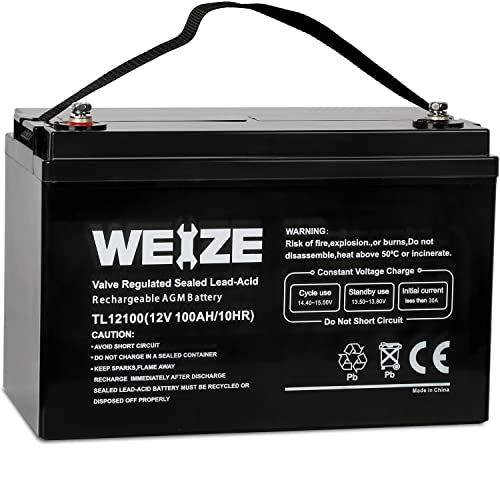
WEIZE’s 100Ah AGM battery emphasizes long storage life and strong discharge capability, with a 1100A max discharge current and a compact, maintenance-free design. Its AGM construction minimizes acid leakage and allows for versatile applications in camping, RVs, and off-grid solar setups. The battery’s operating temperature range supports outdoor use in varied climates, and its low self-discharge rate helps keep stored power usable for extended periods between trips. It’s a practical choice when you need reliable power without frequent upkeep.
Renogy Deep Cycle AGM 12V 200Ah Battery

This 200Ah AGM option from Renogy is designed for higher-demand camping scenarios where longer runtimes are critical. Its high capacity reduces the need for frequent recharges during extended trips or when powering larger devices. The battery’s maintenance-free design, safety features, and strong discharge performance make it a solid choice for campers who plan to run refrigeration, lighting, and multiple devices for days at a time. Compatibility with series and parallel configurations supports scalable power systems for larger campsites or off-grid cabins.
CHITOLI 12V 100Ah LiFePO4 Group 24

CHITOLI’s LiFePO4 battery delivers a light, compact solution with a built-in 100A BMS. The chemistry offers high energy density and an extended lifecycle, making it well-suited for campers seeking lightweight power storage with precise battery management. It is intended for energy storage rather than engine starting, and its smart BMS provides protections against overcharging, over-discharging, over-current, and short circuits. This option excels in quiet, dependable power for electronics, camp lighting, and portable appliances.
FLLYROWER 12V LiFePO4 100Ah With BMS

FLLYROWER’s LiFePO4 option emphasizes cycle life, with claims of up to 16,500 deep cycles and a comprehensive BMS that protects against abnormal temperature, over-discharge, overcharge, short circuits, and overheating. Its modular 5S series compatibility allows scalable voltage configurations (24V, 36V, 48V, etc.) by wiring in series, while parallel configurations can grow capacity. The battery’s lighter weight and compact dimensions suit backcountry rigs and small campers seeking efficient, resilient energy storage.
Buying Guide: Key Purchase Considerations
- Chemistry and weight: AGM batteries are robust and maintenance-free, but LiFePO4 cells offer longer cycle life, higher energy density, and lighter weight—important for portability and longer trips.
- Capacity and runtime: For fridge-heavy camping or extended off-grid living, higher Ah ratings (200Ah or more) may reduce recharge frequency. Match capacity to your expected load and charge source.
- Cycle life and warranty: LiFePO4 options typically provide thousands of cycles; check warranty terms and real-world cycle tests relevant to camping use.
- Safety and maintenance: AGM and LiFePO4 both require proper venting and mounting considerations; LiFePO4 generally presents lower heat risk and more stable chemistry in varied climates.
- Temperature range: Outdoor use demands batteries that tolerate freezing and high temperatures; confirm operating temperature ranges to avoid performance loss or damage.
- Size, weight, and mounting: Ensure fits in your storage space, with compatible mounting hardware and safe transport considerations, especially for RVs and boats.
- Expansion options: Some models allow series or parallel configurations, enabling higher voltages or increased capacity as your energy system grows.
- Maintenance and leakage risk: AGM and LiFePO4 are largely maintenance-free, but proper installation and secure terminals reduce corrosion and leaks.
- Price-to-performance: While LiFePO4 batteries often cost more upfront, their longer life can lower total cost of ownership for frequent campers or long-term off-grid users.
When selecting a camping battery, map your typical trips, expected durations without charging, and equipment demands. If you frequently camp in remote areas with limited charging opportunities, a higher-capacity LiFePO4 option paired with a portable solar setup can offer the best balance of weight, longevity, and reliability. AGM models remain solid choices for more budget-conscious setups or for users prioritizing maintenance-free operation with proven performance.