Choosing the right deep cycle lead-acid battery involves balancing capacity, maintenance needs, and durability for off-grid, RV, marine, or stationary use. The following 5 products represent a range of sealed AGM options designed to minimize maintenance while delivering dependable deep-cycle performance. Each entry includes key specs and typical use cases to help you compare at a glance. The summary table below highlights essential details to help you pick quickly.
| Product | Brand | Voltage | Capacity | Key Strength |
|---|---|---|---|---|
| WEIZE 12V 100Ah AGM Deep Cycle | WEIZE | 12V | 100Ah | Low self-discharge, maintenance-free |
| Renogy Deep Cycle AGM 12V 200Ah | Renogy | 12V | 200Ah | High capacity, low self-discharge |
| WEIZE 12V 100Ah 31 Group | WEIZE | 12V | 100Ah | Compact form, solid discharge |
| VEVOR 12V 40Ah AGM | VEVOR | 12V | 40Ah | Good for mobility devices, compact |
| US Battery US2200 XC2 6V 232Ah (4 Pack) | U.S. Battery | 6V | 232Ah | Strong deep-cycle performance |
WEIZE Deep Cycle AGM 12V 100Ah Battery
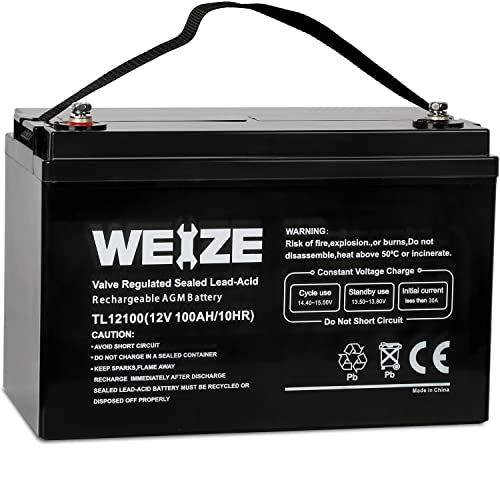
This maintenance-free battery uses AGM technology to minimize acid leakage and reduce maintenance. Compact dimensions are suitable for RVs, solar systems, trolling motors, and off-grid setups. It features a 3% self-discharge rate and a high 1150A max discharge current for quick power bursts. Operating temperature ranges support year-round use, though optimum performance is around 77°F (25°C). Designed to replace traditional flooded lead-acid units with longer storage life when kept charged and within the recommended temperature range.
Renogy Deep Cycle AGM 12V 200Ah Battery

The Renogy 12V 200Ah AGM battery emphasizes low self-discharge and long shelf life. It uses strong plate grids and low internal resistance to support high current discharges while maintaining stability for RVs, off-grid cabins, and boating systems. Its AGM design reduces maintenance needs and minimizes risk of leaks, making it suitable for critical systems with long standby intervals. The battery is designed for reliable, sustained energy delivery across demanding cycles.
WEIZE 12V 100Ah Deep Cycle Battery, 31 Group

This 100Ah sealed lead-acid battery fits multiple applications, including wheelchairs, generators, trolling motors, and small off-grid systems. It emphasizes a maintenance-free experience with a spill-proof design. The form factor aligns with common group size 31 batteries, facilitating straightforward substitutions in existing setups while delivering reliable daily power and longer storage life when maintained properly in an appropriate environment.
VEVOR Deep Cycle 12V 40Ah AGM

The VEVOR 40Ah AGM deep cycle battery targets compact, high-discharge scenarios. It is designed for mobility scooters, electric wheelchairs, go-karts, and light electric devices. With AGM construction and a notable 400A maximum discharge current, it supports short bursts of power while maintaining a manageable size and weight for portable applications. This makes it a practical option where space and weight are critical factors.
US Battery US2200 XC2 6V 232Ah (4 Pack)

The US2200 XC2 pack provides a robust deep-cycle option in 6V increments. Each unit offers extended cycle life and high energy delivery for renewable energy projects, golf carts, and other multi-battery configurations. The compact 6V design allows flexible array builds, and the 232Ah rating supports prolonged operation between charges. The VM/UTL molded terminal design enhances installation reliability in various equipment and storage systems.
Buying Guide: Key Purchase Considerations For Deep Cycle Lead-Acid Batteries
When selecting a deep-cycle lead-acid battery, consider capacity (Ah), voltage, discharge rate, maintenance needs, and the intended application. AGM (absorbed glass mat) designs minimize maintenance and reduce spill risk, making them suitable for mobile or space-constrained setups. For off-grid or backup power, higher Ah ratings extend runtime between charges, but weight and size may limit installation. Temperature tolerance matters for outdoor use; lower self-discharge helps with longer storage between uses. Compatibility with existing equipment (mounting, terminals, and group size) is essential to ensure a proper fit and reliable connections. Battery lifespan depends on charging practices and environmental conditions, so plan for a charging system that supports safe, efficient cycling. Finally, consider warranty terms and supplier support to safeguard your investment over time.
Discharge And Application Perspectives
Deep-cycle batteries are designed for sustained, moderate discharge, unlike car starting batteries. For RVs, solar power setups, and marine uses, prioritize higher capacity and low self-discharge to maximize usable energy over repeated cycles. For mobility devices or portable tools, compact forms with solid discharge performance offer practical, ready-to-use solutions. In every case, ensure the charging source matches the battery’s chemistry and capacity to avoid reduced lifespan or performance issues.