Choosing a reliable OBD code reader helps you quickly diagnose engine problems, monitor real-time data, and streamline repairs. This guide highlights five top-rated readers suitable for most 1996+ vehicles, covering basic code reading, live data, MIL reset, and more. Each option balances ease of use with thorough diagnostic capabilities for DIYers and professional mechanics alike.
The following comparison table summarizes the selected products to help you decide at a glance.
| Product | Brand | Key Features |
|---|---|---|
| ANCEL AD310 Classic | ANCEL | Reads/clears codes, live data, freeze frame, I/M readiness; compact, battery-free power |
| FOXWELL NT301 | FOXWELL | Reads DTCs, live data graphing, VIN retrieval; basic OBD2 functions, no ABS/SRS |
| ANCEL AD410 Enhanced | ANCEL | Comprehensive OBDII diagnostics, 42,000+ DTC lookups, MIL reset, EVAP/O2 testing |
| BlueDriver Bluetooth Pro | BlueDriver | Wireless OBD2 with extensive checks (ABS, SRS, TPMS), repair reports, live data |
| Innova 5210 | Innova | OBD2 scan + battery tester, live data, engine/ABS codes, wide vehicle coverage |
ANCEL AD310 Classic Enhanced Universal OBD II Scanner
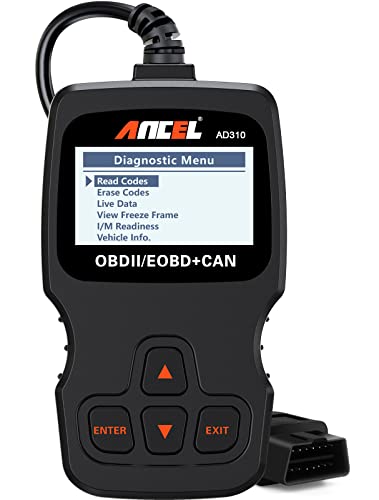
The ANCEL AD310 is a compact, easy-to-use OBD2 scanner that supports most 1996 and newer vehicles. Its design emphasizes portability and straightforward operation, making it suitable for quick checks in a driveway or a shop. It powers directly from the vehicle’s OBDII port, requiring no batteries or external charging. Users can swiftly read and clear emission-related codes, view live data, and access freeze-frame data. The device provides immediate feedback on engine status, helping technicians and informed vehicle owners pinpoint issues without jargon-heavy troubleshooting. A 2.5-foot cable and a clearly labeled interface reduce handling discomfort in tight engine bays, while a small footprint makes it a reliable travel companion.
Limitations include basic diagnostic capabilities compared with more feature-rich models. Some advanced functions—like deep vehicle-specific parameter testing or ABS/SRS diagnostics—are not supported by the AD310. It excels as a budget-friendly, dependable starter tool for routine maintenance checks and quick code clearing, aligning with DIYers who want fast results without a steep learning curve.
FOXWELL NT301 OBD2 Scanner

The FOXWELL NT301 is designed for users who require live data capabilities and reliable code reading without getting into more complex system diagnostics. It can read DTCs, monitor emissions readiness, clear CELs after repairs, and retrieve the VIN of the vehicle. The NT301 supports a broad range of 12V vehicles and offers live data streaming with graphing, which helps users observe trends and detect anomalies in real time. A notable constraint is that it does not support advanced functions in other vehicle systems such as ABS, battery, TPMS, SRS, or programming tasks. This makes NT301 an excellent choice for everyday drivers and professional technicians who need efficient, accurate fault code reading and data visualization without overextending the device’s scope.
Users should verify vehicle compatibility for specific makes/models, and remember that clearing a fault code typically requires the underlying issue to be resolved first. The NT301 excels as a mid-range tool for dependable diagnostics and data-driven decision-making.
ANCEL AD410 Enhanced OBD2 Scanner

The AD410 is a more capable option within ANCEL’s lineup, offering enhanced OBDII diagnostics with broad compatibility across OBDII, CAN, and related protocols. It promises rapid fault code reading and clearing across a wide array of 1996+ vehicles, including support for monitoring devices like O2 sensors and EVAP systems. It provides robust DTC lookup capabilities and a deep library of code definitions, which can help identify root causes more accurately, especially when dealing with emissions-related issues. It’s important to note that while AD410 provides extensive engine-focused diagnostics, it does not claim full support for all systems such as ABS or transmission in every vehicle. This makes it a strong choice for users who want more depth than a basic scanner without entering the complexity of professional-grade tools.
Power is drawn directly from the vehicle via the OBDII port, eliminating the need for external power sources. The device is best used by those who value a comprehensive database and speed in troubleshooting engine-related problems.
BlueDriver Bluetooth Pro OBDII Scan Tool
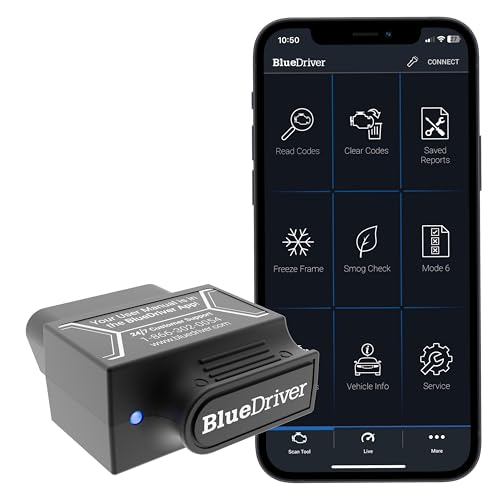
The BlueDriver Bluetooth Pro delivers wireless, smartphone-connected diagnostics suitable for iPhone and Android users. It’s designed to replace traditional wired scanners with a subscription-free model that covers a broad range of issues, including ABS, SRS, airbag, and TPMS codes, among many others. BlueDriver enhances standard code reading with repair reports that provide possible causes and fixes, helping users decide on the best course of action. Real-time data is available and can be monitored as you drive, giving a continuous overview of vehicle health. While the tool is powerful, some users may prefer plug-and-play, non-wireless options, particularly in areas with Bluetooth interference or in environments where a phone isn’t convenient to use under the hood.
BlueDriver is ideal for vehicle owners who want a comprehensive, highly user-friendly diagnostic experience with actionable repair insights and no ongoing subscription fees for basic features. It emphasizes long-term value through repair guidance, beyond mere code reading.
Innova 5210 OBD2 Scanner

The Innova 5210 combines OBD2 scanning with a dedicated battery tester, enabling users to assess alternator health alongside engine diagnostics. This all-in-one approach suits users who want more than a standard code reader, offering live data streams and readiness checks to help pass emissions testing. The tool supports a broad range of 1996+ vehicles and includes coverage for ABS where available, enhancing its utility in a wider diagnostic workflow. As with most diagnostic devices, coverage may vary by vehicle model, so checking Innova’s compatibility checker before purchase is advisable.
Innova’s combination of live data, battery testing, and straightforward operation positions it as a strong mid-to-upper range option for those who prefer a single-tool solution for both engine diagnostics and battery health assessment.
Buying Guide: Key Purchase Considerations
- Vehicle compatibility: Confirm that the scanner supports your make, model year, and headache-free operation on your typical vehicles. Some models only offer basic OBD2 functionality, while others add extended features.
- Diagnostic scope: Decide if you need basic code reading, live data, freeze-frame, EVAP tests, or advanced DTC libraries. If you work on cars professionally, a model with a comprehensive DTC database and live data graphs is beneficial.
- Power and connection: Consider whether you prefer a wired scanner that plugs into the OBDII port or a wireless option (Bluetooth/Wi-Fi) that syncs with a smartphone or tablet. Wireless tools offer convenience but require compatible devices and sometimes pairing steps.
- Data presentation: Look for clear, interpretable code definitions, live data charts, and the ability to save or export data. Graphing can help identify intermittent issues more effectively than static codes alone.
- Ease of use and build quality: A compact, durable design with intuitive menus reduces learning time and frustration. Check for durable cables, legible displays, and robust construction for workshop environments.
- Support and updates: Some tools offer ongoing software updates and robust DV/DTC libraries. Consider brands with reliable customer support and readily accessible documentation.
- Price-to-value balance: While premium models offer deeper diagnostics, entry-level scanners cover most common uses. Align your choice with how often you diagnose vehicles and whether you need features like VIN retrieval or repair reports.