Finding a reliable portable marine battery charger is essential for keeping boats ready for the water. The right charger can maintain, repair, and optimize a range of battery chemistries—from flooded lead-acid to LiFePO4—while standing up to harsh marine conditions. Below is a carefully selected guide to five top performers that balance charging speed, safety features, and rugged design. Each option is suitable for boats, pontoons, and other watercraft equipment, helping you extend battery life and ensure dependable starts on shore or at sea.
Summary Table of Selected Products
| Product | Brand | Battery Types | Key Strengths |
|---|---|---|---|
| YONHAN 20A/12V-24V Charger | YONHAN | Lead-Acid, LiFePO4, AGM, Gel, Deep-Cycle | 7-stage charging, winter mode, repair function |
| NOCO GENIUS1 | NOCO | Lead-Acid, LiFePO4 | Thermal compensation, compact, versatile |
| NOCO GEN5X2 | NOCO | Lead-Acid, Lithium | Two banks, independent charging, robust |
| NOCO GENIUS5 | NOCO | Lead-Acid, Lithium | Five-amp per unit performance, compact |
| FirstPower Pro 10X3 | FirstPower Pro | Lead-Acid, LiFePO4, Calcium | 3 banks, independent modes, IP68 waterproof |
YONHAN Battery Charger 20A 12V/24V Review

The YONHAN charger combines 12V 20A and 24V 10A outputs in a seven-stage charger designed for a wide range of battery chemistries, including LiFePO4, AGM, GEL, and flooded lead-acid. It promotes fast charging while protecting against overcurrent and short circuits. With winter mode and smart control for temperature adaptation, it helps prevent battery drain in cold months or while the boat sits unused. A built-in repair mode targets aging, idle, or lightly depleted batteries, extending life without requiring a jump starter.
Designed for marine and outdoor use, this unit includes reverse protection, a cooling system, and fireproof materials to improve safety in cramped engine bays. While it excels at maintenance and recovery, note that it does not function as a jump starter and must be plugged into mains power to operate. This makes it ideal for dockside charging or on-shore storage scenarios where stable AC power is available.
NOCO GENIUS1 Battery Charger and Maintainer

NOCO GENIUS1 is a compact, automatic charger and maintainer compatible with 6V and 12V lead-acid and LiFePO4 batteries. It features a thermal sensor that adjusts charging in response to ambient temperatures, helping prevent overcharging in heat and undercharging in cold. The charging solution combines desulfation with trickle charging and an integrated overload protection system, making it a solid choice for boats that require a small, reliable maintainer. Its size makes it easy to install in tight bilge compartments or cockpit lockers.
While optimized for smaller battery systems, GENIUS1 excels in maintaining critical batteries for extended periods, such as winter storage. It’s not intended for high-amperage induction charging but provides precise, safe maintenance to keep batteries ready for the next voyage. For single-battery rigs or weekend boats, this unit provides a dependable balance of efficiency and protection.
NOCO GEN5X2: Two Banks Onboard Charger
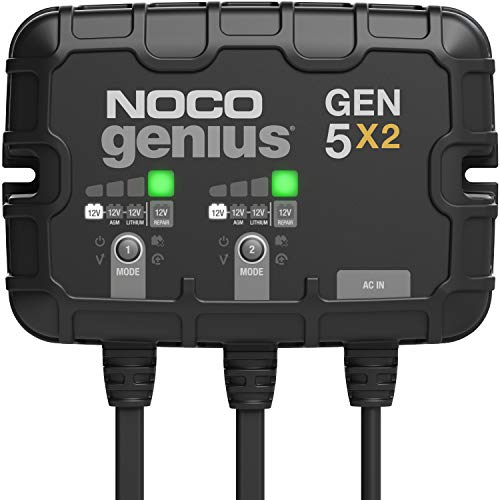
NOCO GEN5X2 is a two-bank onboard charger designed for marine and other demanding environments. With 10A total (5A per bank) and independent charging for each bank, it supports 12V lead-acid and lithium systems, including solar, AGM, Gel, and deep-cycle configurations. Each bank can be set to 12V, 12V AGM, or 12V Lithium, and a dedicated repair mode helps address sulfation and low-voltage issues. Its compact footprint suits tight engine rooms while delivering robust performance across multiple batteries in parallel.
Users should consider the complexity of managing two banks versus a single-bank unit. The GEN5X2 is an excellent option for boats with dual battery setups or separate starting and house batteries. While it provides strong cross-bank flexibility, ensuring correct mode selection per battery type is important to maximize effectiveness and battery life.
NOCO GENIUS5: Versatile 5-Amp Charger

NOCO GENIUS5 offers a higher power level with five amps of charging per unit, suitable for mid-sized boats and more demanding maintenance cycles. It supports 6V and 12V lead-acid and lithium systems, including flooded, maintenance-free, deep-cycle, and marine batteries. The integrated thermal sensor preserves battery health by adapting to ambient temperature, reducing risks of overcharging during hot seasons and ensuring complete charging in cooler climates. The device combines the functions of a battery charger, maintainer, trickle charger, and desulfator in a compact package.
For boats with multiple critical batteries or those requiring longer-term storage readiness, GENIUS5 provides a strong balance of speed, protection, and convenience. It is not a high-output charger for large power draws, but it excels at keeping batteries healthy and ready between trips, preserving performance without manual intervention.
FirstPower Pro 10X3 Marine Charger

The Upgraded 3 Bank Marine Battery Charger 10X3 offers three independent charging channels, delivering 10A per bank for a total of 30A. It is IP68 waterproof and designed for constant onboard operation, suitable for 12V SLA/AGM, 12V Lithium, and Calcium batteries. Each bank can be set to its own mode using a MODE control, enabling precise charging for different battery chemistries in parallel. A notable feature is Force Mode, which allows charging dead or near-dead batteries by manually activating charging with a long press. This makes it a solid fit for boats that require rapid recovery of multiple battery banks.
While highly capable, the unit’s complexity requires clear labeling and appropriate setup to avoid cross-connecting incompatible battery types. For crews that manage several battery banks on larger vessels, the FirstPower Pro unit streamlines maintenance and recovery, keeping critical systems powered during long trips or in coastal environments where shore power is intermittently available.
Buying Guide: Key Purchase Considerations
- Battery Chemistry Support: Look for chargers that explicitly support lead-acid variants (AGM, Gel, Calcium) and LiFePO4. Marine boats often combine different chemistries, making broad compatibility essential.
- Bank Configuration: Single-bank units work well for small boats with one starting/home battery. Multi-bank chargers (two or three banks) suit boats with separate starting and house batteries or multiple deep-cycle packs.
- Charging Speed vs. Safety: Higher amperage charges faster but can stress smaller batteries. Ensure the charger includes temperature compensation, smart cutting, and protections (overcurrent, overcharge, short circuit) to preserve battery life.
- Waterproof Rating: For onboard use, IP68 or similar ratings are preferred to withstand splashes, humidity, and potential submersion during rough conditions.
- Maintenance Features: Desulfation and repair modes can extend the life of older batteries, but not all batteries respond to repair cycles. Use these features as part of a broader maintenance plan.
- Ease of Use: Multi-bank units require clear labeling and simple mode selection to prevent charging the wrong battery type. Consider units with auto-detection features if available.
- Size and Install Footprint: Compact units suit tight engine rooms, while larger multi-bank units may demand more space. Verify mounting options and cable lengths before purchasing.
- Safety Certifications: Check for certifications and compliance with marine electrical standards to ensure safe operation aboard watercraft.
When choosing a portable marine battery charger, align the unit with your vessel’s battery configuration, available shore power, and climate conditions. For boats stored ashore during colder months, a charger with winter mode and robust trickle maintenance can help prevent sulfate buildup and battery drain. For vessels with multiple batteries, a multi-bank charger may reduce maintenance time while preserving battery health across circuits. Always follow the manufacturer’s guidelines for installation and use to maximize performance and safety on the water.