RV owners rely on dependable battery charging to keep auxiliary systems, lights, and 12V appliances running. The right charger can maintain, protect, and extend the life of both lead‑acid and lithium batteries while adapting to temperature and different charging needs. Below are five top-rated chargers designed for 6V and 12V systems, along with practical buying considerations to help you choose the best fit for your RV lifestyle.
Summary Of Chosen Products
- Noco GENIUS1: 1A 6V/12V Smart Battery Charger — Automatic Maintainer, Trickle Charger & Desulfator
- Noco GENIUS2D: 2A 12V Smart Onboard Battery Charger — Direct-M mount, Maintainer & Desulfator
- Noco GENIUS5: 5A 6V/12V Smart Battery Charger — Maintainer, Trickle & Desulfator
- Noco GENIUS2: 2A 6V/12V Smart Battery Charger — All‑in‑one maintenance charger
- Noco GENIUS2X2: 4A 2‑Bank Smart Battery Charger — Dual bank maintenance charger
NOCO GENIUS1: Compact 1A Battery Charger and Maintainer

The NOCO GENIUS1 combines charging, maintenance, tricle charging, and desulfation in a compact unit. It supports 6V and 12V lead‑acid batteries (including AGM, Gel, SLA, VRLA) and LiFePO4 Lithium batteries, making it versatile for RV house batteries, starting batteries, and auxiliary packs. An integrated thermal sensor dynamically adjusts charging to ambient conditions, protecting against overcharge in heat and undercharge in cold weather. This precise temperature compensation helps maximize battery life in variable RV environments.
NOCO GENIUS2D: Onboard 2A Smart Battery Charger
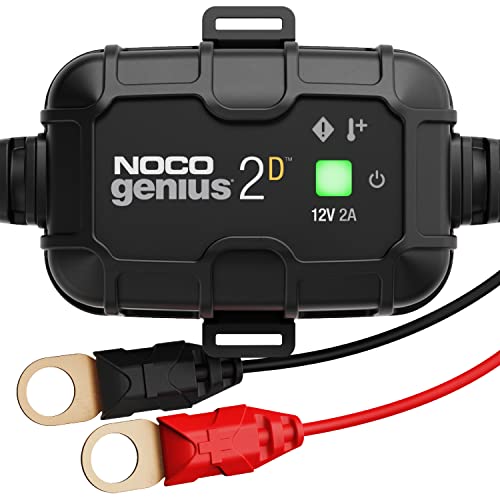
Designed for seamless under‑the‑hood installation, the GENIUS2D offers a direct‑mount form factor with a 2A capacity for 12V lead‑acid batteries, including flooded, AGM, and VRLA variants typical in RVs. It serves as a full charging solution—charger, maintainer, trickle charger, and desulfator—while a robust mounting bracket provides secure attachment. Temperature compensation keeps performance steady across RV engine bay heat or cool nights at the travel campsite, ensuring ready power for lights and appliances.
NOCO GENIUS5: Higher‑Power 5A Battery Charger

The GENIUS5 increases charging capacity to 5A while maintaining the all‑in‑one package: charger, maintainer, trickle charger, and desulfator. It supports 6V and 12V lead‑acid and LiFePO4 batteries and improves efficiency with a compact footprint. The integrated thermal sensor helps optimize performance, minimizing heat damage on hot days and preserving charge during cold nights, a common challenge for RV owners on extended trips.
NOCO GENIUS2: Smart 2A Charge For 6V/12V Systems

The GENIUS2 lays out a versatile 2A charger that handles both 6V and 12V batteries, including lead‑acid and LiFePO4 types. It functions as a comprehensive maintenance device with temperature compensation and desulfation, helping RV owners recover and maintain battery health during long trips or seasonal storage. The device also includes a force mode to target very low voltage batteries, enabling a deeper level of maintenance for older packs encountered on some RVs.
NOCO GENIUS2X2: Dual 2‑Bank 4A Charger

The GENIUS2X2 delivers 4A total across two banks, enabling simultaneous charging of two batteries—ideal for RVs with separate chassis and house batteries, or two auxiliary packs. It maintains the all‑in‑one charge family features, including automatic maintenance, desulfation, and temperature compensation. This setup provides flexibility for RVs with multiple battery configurations while preserving energy efficiency and battery health.
Buying Guide: Key Purchase Considerations
- Battery chemistry compatibility: Ensure the charger supports both lead‑acid and LiFePO4 options if your RV uses mixed chemistries. Temperature compensation helps protect against overcharge in heat and undercharge in cold environments.
- Voltage and current needs: For small RV setups, a 1–2A charger may suffice for maintenance, but more demanding 5A units are better for faster restoration or larger battery banks. Multiple banks can be charged simultaneously with dual‑bank models.
- Mounting and installation: Onboard or direct‑mount models simplify wiring and keep the charger out of the way, reducing exposure to vibrations and weather in rough campsites.
- Desulfation and battery recovery: Desulfator features help revive certain flooded lead‑acid batteries, potentially extending their usable life but not guaranteed for severely degraded cells.
- Weather and environment: Outdoor or exposed RV bays benefit from sealed enclosures and high‑quality insulation to protect electronics from moisture and temperature swings.
- Maintenance vs. charging speed: Trickle maintenance is essential for long durations in storage, while higher amperage chargers accelerate replenishment after use.
- Ease of use: Look for user‑friendly interfaces, clear indicators, and automatic shutoff features to prevent user error and battery damage.
- Warranty and support: A solid warranty and accessible customer support can be valuable when diagnosing compatibility with your RV’s batteries and electrical system.
Additional Considerations: RV-Specific Scenarios
For full‑time RVers, a dual‑bank charger can independently manage a chassis and a house battery system, keeping critical starting power ready while maintaining living‑area power reserves. For seasonal travelers, onboard chargers reduce the need to remove batteries for winter storage, protecting the battery through temperature shifts. If your RV relies on solar panels, a charger with voltage regulation and compatibility with LiFePO4 batteries can help maintain a healthy state of charge during sunless periods through the year.
Compatibility Checklist
- Confirm battery type: Lead‑acid, AGM, Gel, VRLA, and LiFePO4 compatibility
- Check voltage range: 6V and/or 12V depending on your battery setup
- Decide on single vs. dual bank: One charger or two independent circuits
- Evaluate installation space: Onboard vs. remote mounting
- Assess climate and exposure: Weatherproof models for outdoor RV bays