Planning a solar upgrade for a car roof or compact RV? This article highlights five top solar panels suited for curved or tight spaces on vans, campers, boats, and off-grid vehicles. Each option prioritizes lightweight design, high efficiency, and flexible mounting to optimize rooftop power without compromising space. Read on to compare sizes, durability, and performance characteristics to choose a solution that fits your vehicle and energy needs.
| Product | Brand | Key Benefit |
|---|---|---|
| Renogy 200W N-Type 24V | Renogy | Compact, high efficiency for tight spaces |
| Renogy 100W Flexible 12V | Renogy | Ultra-lightweight, curved surfaces |
| Renogy 100W Flexible 12V (Semi-Flex) | Renogy | Very flexible, thin profile |
| ECO-WORTHY 200W Kit | ECO-WORTHY | Balanced kit with PWM controller |
| ECO-WORTHY 130W Flexible Kit | ECO-WORTHY | Flexible kit for curved surfaces |
Renogy 200W N-Type 24V Solar Panel

Renogy’s 200W N-Type module is designed for compact spaces, such as Class B vans. It measures 7.5% smaller and weighs 11.7% less than earlier designs while delivering the same power output. The panel achieves 25% cell efficiency using advanced 16BB cell technology, which improves energy conversion and reduces microcrack risks, especially in high temperatures. The 24V configuration minimizes current loss and enhances overall system efficiency, with compatibility for both 12V and 24V battery banks, offering flexible installation options for rooftop mounts on vans, RVs, boats, or cabins.
Renogy 100W Flexible Solar Panel 12V
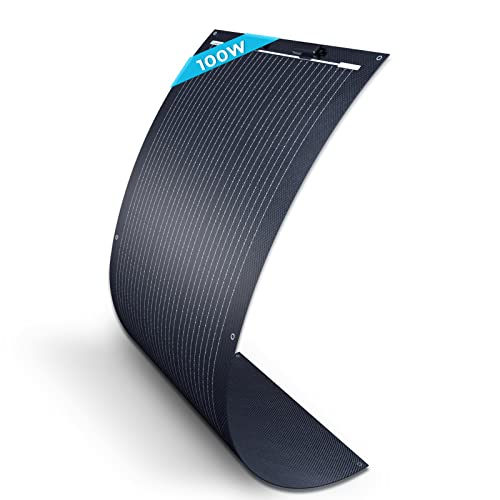
This 100W flexible panel delivers high output while remaining highly portable. It is ideal for curved surfaces on marine vessels, RVs, and vans. The panel can provide an approximate daily energy yield around 500 Wh, depending on sun availability. It’s foldable enough to transport easily and is designed to bend up to 240 degrees, enabling installation on curved roofs or non-traditional mounting areas. Half-cut PERC cell technology boosts light capture and electrical performance, improving efficiency in diffuse light and partial shading scenarios.
Renogy Flexible 100W Mono Solar Panel (Semi-Flexible)

This semi-flexible 100W panel focuses on a very thin build and ultra-lightweight profile, making it well-suited for stealth installations on cars, vans, and small campers. It weighs substantially less than rigid panels—about 70% lighter—facilitating easy handling and fast mounting. The laminated construction and ultra-thin lamination keep the panel low-profile, nearly flat when installed, and suitable for uneven or curved roof surfaces.
ECO-WORTHY 200W Solar Panel Kit

This kit pairs a 200W monocrystalline panel with a 30A PWM charge controller, designed for RVs, campers, and off-grid setups. ECO-WORTHY emphasizes wide applicability, supporting 12V and 24V battery configurations and delivering a robust daily output under favorable sun conditions. The panel features a corrosion-resistant aluminum frame, a waterproof IP65-rated junction box, and reliable performance in windy or snowy environments. It’s a practical all-in-one option for DIY rooftop installations on caravans or cabins.
ECO-WORTHY 130W Flexible Panel Kit

This 130W flexible kit is designed for golf carts, RVs, boats, and other curved surfaces. It delivers an estimated 520Wh of daily energy under typical sunlight. The kit includes a 48V/60V/72V MPPT boost controller capable of maximizing charging efficiency with a wide range of battery chemistries, including lead-acid and lithium. The flexible panel offers a low-profile, stealthy installation and is lightweight for straightforward mounting on non-flat surfaces.
Buying Guide: Key Purchase Considerations For Car Roof Solar
When selecting a solar panel system for a car roof or compact vehicle, consider these factors to balance performance with installability and cost:
- Roof compatibility and mounting: Curved roofs or tight spaces benefit from flexible panels or compact rigid modules. Check mounting hardware compatibility and wind load ratings for your vehicle type.
- Power requirements: Estimate daily energy usage (in watt-hours) and desired autonomy. A higher wattage panel or modular kit can cover more daily consumption, especially in cloudy climates.
- Voltage and battery compatibility: 12V vs 24V systems affect wiring, charge controller choice, and overall efficiency. Confirm compatibility with existing or planned battery banks.
- Efficiency and temperature performance: Panels with high cell efficiency and good low-light performance maintain output in overcast conditions or heat, common on rooftop installations.
- Durability and weather resistance: Look for corrosion-resistant frames, IP ratings, and robust junction boxes. Consider panels designed for marine or off-road use if exposure is a concern.
- Flexibility vs. rigidity: Flexible panels are easier to mount on curved surfaces but may be more fragile over time. Rigid panels often offer higher durability and easier frame mounting for flat roofs.
- Installation ease: Some kits include PWM or MPPT controllers; MPPT controllers optimize charging, especially with varying sun exposure. Ensure manufacturer-specified wiring, fuses, and mounting hardware meet safety standards.
- Expandability: If future energy needs could rise, choose a modular approach that allows adding more panels or upgrading controllers without replacing the entire system.
- Warranty and support: A longer warranty and accessible customer support reduce long-term maintenance concerns on remote or off-grid setups.
These considerations help in selecting a system that delivers reliable rooftop power for camping, van living, or marine use, while keeping installation practical and safe on moving vehicles.