Choosing a universal scan tool can be daunting with so many models and features. This guide highlights five strong options that cover common needs—from quick fault code reading to live data, EVAP testing, and more. Each pick is evaluated for compatibility, ease of use, and diagnostic depth to help you decide which tool best fits your vehicle and skills.
| Product | Brand | Key Strengths | Notes |
|---|---|---|---|
| ANCEL AD310 Classic Enhanced | ANCEL | Read/clear codes, live data, I/M readiness, freeze frame | Compact, power via OBD-II; strong starter tool |
| ANCEL AD410 Enhanced OBD2 Scanner | ANCEL | Wide compatibility, extensive DTC library, EVAP/O2 tests | Advanced diagnostics; no ABS/SRS support |
| BlueDriver Bluetooth Pro | BlueDriver | Bluetooth connectivity, unlimited repair reports, live data | Requires smartphone app; extensive issue database |
| FOXWELL NT604 Elite | FOXWELL | 5-in-1: ABS/SRS/engine/transmission; I/M readiness; live data | New version; strong all-system coverage |
| Motivora Professional Universal | Motivora | 50,000+ DTC library; I/M readiness; live data | Professional-grade features; clears codes after underlying issue |
These selections balance broad compatibility, depth of diagnostics, and value. The following sections offer detailed, objective overviews of each tool, followed by a buying guide to help you compare features and make an informed choice.
ANCEL AD310 Classic Enhanced Universal OBD II Scanner

The AD310 is positioned as an affordable starter OBD II scanner that’s widely recommended by automotive influencers. It supports reading and clearing diagnostic trouble codes for emissions systems, and it can display live data, freeze frame, I/M monitor readiness, and vehicle information. The device is powered via the vehicle’s OBD II port, eliminating the need for separate batteries or chargers. Its compact design weighs about 12 ounces, with a 2.5-foot cable and clearly labeled buttons for straightforward operation. The AD310 is well-suited for quick checks or basic repairs in home garages and shops.
Features emphasize speed and usability: quick code retrieval, direct access to engine fault details, and practical data views. While it covers standard OBD II vehicles (1996 and newer), it focuses on core functions rather than multi-system diagnostics. The AD310’s physical design—compact, with a bright display—helps technicians and DIYers read results clearly, even in tight engine bays. For basic code reading and light maintenance, it’s a reliable, widely supported choice.
ANCEL AD410 Enhanced OBD2 Scanner

The AD410 expands on the basic OBD2 capabilities with broader compatibility and an extensive code library. It supports all 16-pin OBDII vehicles and is designed to be a robust diagnostic companion for both domestic and international models. It includes multilingual support and relies directly on the vehicle’s power without external batteries or chargers. A key advantage is its 42,000+ DTC lookup library, which helps users identify faults quickly and understand whether fixes are appropriate before repair work begins.
Beyond fault code reading and clearing, the AD410 performs enhanced diagnostics such as EVAP and O2 sensor tests. This makes it a solid option for users who want more depth than entry-level tools without stepping into professional-grade gear. It does have a limitation: it does not support ABS, SRS, or transmission diagnoses, which matters if your issue lies outside the engine management system.
BlueDriver Bluetooth Pro OBDII Scan Tool
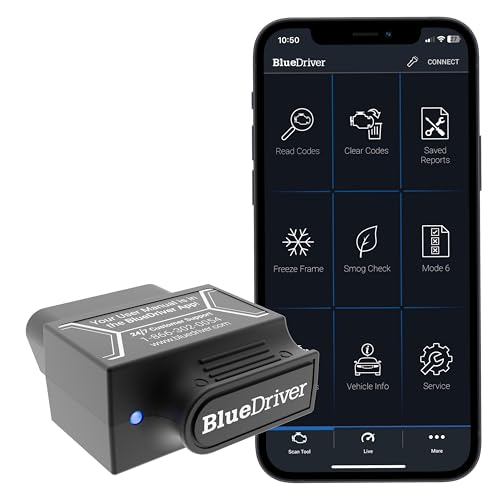
BlueDriver operates as a Bluetooth-enabled diagnostic tool paired with a mobile app, offering an experience closer to professional-grade scanners without a laptop. It reads and clears trouble codes and provides an extensive diagnostic view that includes ABS, Airbag (SRS), and TPMS codes, with live data monitoring. It’s designed for iPhone and Android, giving users access to repair reports that include potential fixes. A standout feature is the expansive database of 7,000+ known issues, with ongoing updates to improve accuracy and coverage.
BlueDriver is ideal for smartphone users who want a portable, subscription-free solution. The app-driven approach makes it convenient to share results and repair plans, especially for those who prefer a cloud-backed archive of vehicle diagnostics. However, the experience depends on mobile device performance and app stability, which can be a consideration for some users.
FOXWELL NT604 Elite OBD2 Scanner

The FOXWELL NT604 Elite represents a multi-system diagnostic approach, designed to check engine, ABS, SRS, and transmission systems. This 5-in-1 capability makes it a versatile tool for car owners who want to diagnose a broad range of issues. The 2026 version ships with updated software, ready to use out of the box, and includes a built-in DTC library for rapid fault code interpretation. It also features data playback, live data streams, and the ability to print results, which is helpful for repairs or shop documentation.
A notable caveat is that the NT604 Elite does not clear all types of system faults (e.g., certain airbag data) and its capabilities can be limited by vehicle-specific security features. For those needing a comprehensive snapshot across multiple subsystems, this tool offers balanced performance and value in a single device.
MOTOPOWER MP69033 Car OBD2 Scanner

The MP69033 is a practical option with a broad protocol range to support most OBD II and CAN vehicles from 1996 onward. It features a versatile 2.8-inch LCD display with backlight for clear viewing of live data, DTC reading, freeze frame data, I/M readiness, and vehicle information. It is powered directly via the OBDII port, eliminating the need for external power sources. The MP69033 emphasizes ease of use and quick diagnostics, suitable for home garages and shop environments where straightforward, reliable performance is essential.
With its multilingual support and broad vehicle compatibility, this model is well-suited for users who service diverse vehicle fleets. The tool prioritizes core management functions such as read/erase codes, display live data, and monitor readiness, while keeping the interface approachable for less experienced users.
Buying Guide: Key Purchase Considerations
What to look for in a universal scan tool
- Vehicle compatibility: Ensure the tool supports your vehicle’s year, make, model, and the required protocols (OBDII, CAN, etc.).
- Depth of diagnostics: Decide whether you need basic code reading, live data, I/M readiness, EVAP tests, or ABS/SRS/transmission coverage.
- Data presentation: Consider display clarity, whether the device provides a graph, and how easy it is to interpret results.
- Power and independence: Tools that draw power from the OBD II port are convenient, but consider battery-free operation and the device’s physical durability.
- Updateability: Look for ongoing software updates and a robust DTC library to stay current with fixes.
- Connectivity: If you prefer mobile apps, Bluetooth-enabled models with reputable apps can be very convenient; ensure compatibility with your phone’s OS.
- Support and documentation: Access to manuals, customer support, and a clear user guide can reduce learning curves and misinterpretation of results.
- Price-to-value balance: More features typically mean higher cost. Match features to your actual use, whether it’s casual DIY or professional diagnostic work.
Different user perspectives
- DIY car owners: Prioritize ease of use, essential functions (code reading/clearing, live data), portability, and price. A straightforward tool with clear results can save time and money.
- Professional technicians: Value comprehensive system coverage (ABS/SRS/transmission), larger DTC libraries, data logging, and the ability to generate repair reports or prints for customers.
- Fleet managers: Look for durable builds, network-friendly data sharing, and reliable service options that support multiple vehicle types and brands.
- Tech enthusiasts: Prefer tools with broad compatibility, deep diagnostic capabilities, and frequent software updates to tackle uncommon codes.
All five highlighted tools provide solid options for different users. When choosing, align your pick with your vehicle types, expected diagnostics depth, preferred interface, and whether you value cloud or offline capabilities. This approach ensures you select a universal scan tool that meets your needs today and remains useful as you encounter new vehicles in the future.